
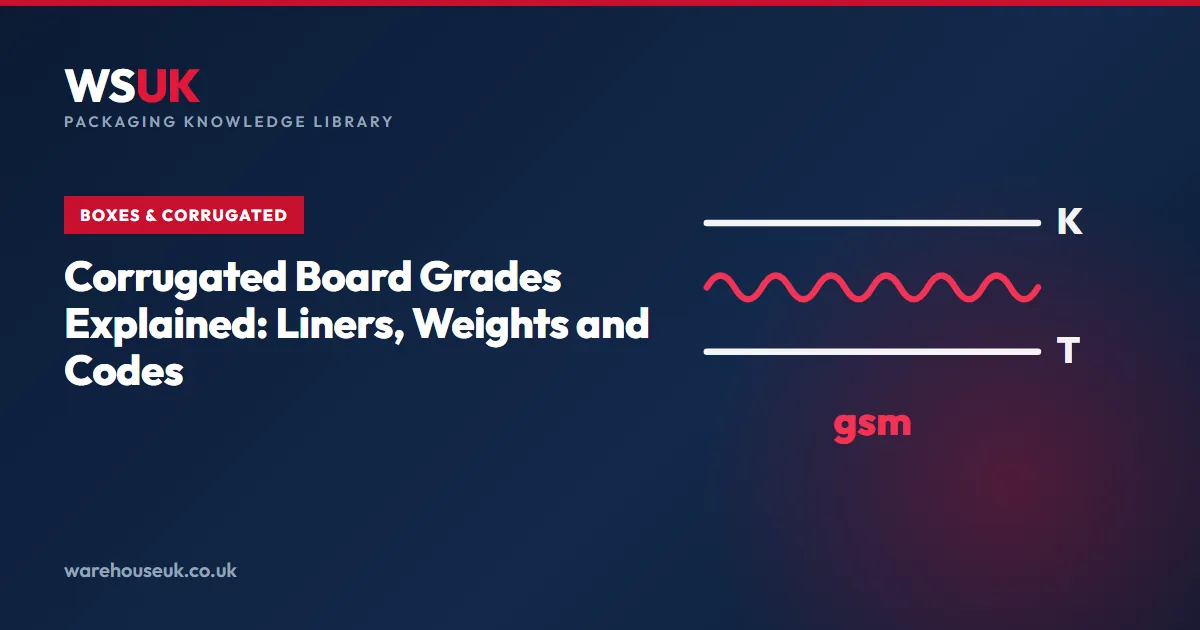
A corrugated board grade names the papers in a board: the outer liner, the inner liner and the flute. In UK shorthand such as 150K/150T C, the numbers are paper weights in gsm, K is kraft liner, T is test liner and the letter is the flute. The grade is the recipe; burst and edge crush are the result.
What a board grade describes
A corrugated board grade is a recipe written in shorthand. It says which papers go into the board and how heavy each one is, and it is the line on a carton quote that buyers most often skip, because it looks like a part number.
Every corrugated board is built from two kinds of paper. Liners are the flat sheets on the faces, and the fluting medium is the wavy sheet glued between them. Single wall board has two liners and one fluting; double wall has three liners and two flutings, with a middle liner separating them. The grade specifies those papers and the flute profile.
The grade is not the same as performance. It is an input to strength, not a measure of it, and two boards with the same code from different mills can test differently. That is why a sound specification across our corrugated packaging range records the grade and the performance figures together: the grade so a reorder is the same build, the burst and edge crush values so the board can be checked against its load.
Liner types: kraft, test, white-top and mottled
Kraft liner
Kraft liner, shown as K, is made with a high proportion of virgin fibre, usually from softwood pulp. Long, unbroken fibres give it more tensile and burst strength for its weight and better resistance to damp, and its brown face is firm and takes scuffing well. It costs more than test liner, so it usually goes on the outside, where it meets handling, weather and print.
Test liner
Test liner, shown as T, is made largely or wholly from recycled fibre. Recycled fibre is shorter and weaker, so a test liner is generally less strong than kraft at the same weight and loses more of its strength when damp. It is the economical choice for inner faces, short and dry journeys and general despatch where the box is not under heavy load for long. Test liners are made in different qualities of their own, so "T" on a quote does not settle the question by itself.
White-top and mottled liners
White-top liners have a bleached white layer over a brown base, on either a kraft or a test sheet, and give a clean surface for printed and retail outers. Mottled liners have a partly white, uneven face with some brown fibre showing through. They cost less than a full white top and suit one- or two-colour print where a pure white background is not needed.
| Liner | Fibre | Strength for its weight | In damp conditions | Face and print | Usually used for |
|---|---|---|---|---|---|
| Kraft (K) | Mostly virgin | Higher | Holds strength better | Brown, firm, scuff resistant | Outer faces, heavier goods, export |
| Test (T) | Recycled | Lower | Loses more strength | Brown, less uniform | Inner faces, general and dry despatch |
| White-top | White layer on a kraft or test base | Follows the base sheet | Follows the base sheet | Clean white, best for full colour | Printed and retail outers |
| Mottled | Partly white top on a base sheet | Follows the base sheet | Follows the base sheet | Off-white, flecked | Simple print at lower cost |
Paper weights and the fluting medium
Each paper is specified by weight in grams per square metre (gsm). Heavier paper carries more fibre and is generally stronger, but weight and fibre type work together: a lighter kraft can outperform a heavier test liner on burst, so comparing two codes by the numbers alone misleads. Liner weights such as 125, 150 and 200 gsm are common on quotes, with heavier papers reserved for demanding builds.
The fluting medium is the paper formed into the wave. It rarely gets a mention on a quote, yet it does much of the work when boxes are stacked, because the flutes act as columns holding the liners apart. It is made either from recycled fibre or as semi-chemical fluting, which uses virgin hardwood fibre and gives a stiffer flute with better crush resistance. If a code does not state the fluting, ask what the supplier's standard medium is.
The flute letter then sets the height of the wave: roughly 1.1 to 1.6 mm for E flute, 2.5 to 3.0 mm for B, 3.5 to 4.0 mm for C and 6 to 7 mm for BC double wall. The full set of profiles and their uses is listed under packaging materials and flute profiles.
Reading a grade code
There is no single convention for writing a grade, and the format varies by supplier, but a common UK shorthand reads like this. In 150K/150T C, 150K is the outer liner, kraft at 150 gsm; 150T is the inner liner, test at 150 gsm; and C is the flute, so this is a single wall board. Double wall adds a middle liner and a second flute, so 150K/125T/150T BC would read as a kraft outer, a test middle liner and a test inner on BC flute.
Variations are common. Some suppliers write fluting weights between the liners or add letters for the medium, white-top and mottled liners carry letters that differ by supplier, and the order of faces is not universal. Ask for the key if a quote does not give one.
| Example code | How it reads | Where a build like this often sits |
|---|---|---|
| 125T/125T B | Test liner both faces, B flute, single wall | Light goods, short and dry journeys |
| 150K/150T C | Kraft outer, test inner, C flute, single wall | General shipping cartons with moderate stacking |
| 150K/150K C | Kraft both faces, C flute, single wall | Denser contents, damper routes |
| 150K/125T/150T BC | Kraft outer, test middle and inner, BC flute, double wall | Heavier cartons and palletised loads |
The grade code tells you what the board is made of; the test figures tell you what it will do. A specification needs both.
Reading a quote and choosing a grade
Reading a quote
When two quotes for what looks like the same box differ in price, the grade line is usually why. Check:
- Which face is which. If you are paying for kraft, confirm it is on the outside.
- Whether the fluting is stated. A quote that names only the liners leaves the medium to the supplier.
- Whether performance figures are given. A code alone says what the board is made of, not what it will carry.
- Whether the box style matches. Styles have their own FEFCO codes, such as 0201 for a regular slotted case, separate from the board grade.
- Whether the grade is written into the specification, so a reorder is the same board.
A cheaper quote on a lighter or all-test grade is not automatically a worse one. On a short, dry route with little weight above, it may be exactly right. The wider checklist of dimensions, style and closure is in our guide to specifying the right cardboard box.
Choosing a grade by stack load
Stack load decides the board. Work out what sits on the bottom carton, for how long and in what conditions, then choose flute, wall and papers to carry it. Where cartons are crushing in the stack, the remedy is usually more column strength from the flute, the wall construction or a stiffer medium, rather than a heavier outer liner, which tends to lift burst more than stacking. Where cartons travel damp or sit in a cold store, kraft liners hold their strength better. Where cartons are being punctured rather than crushed, liner weight and type are the lever. If boxes are already failing, start with why packaging gets crushed in transit.
Choosing a grade for print
Print adds a second requirement to the outer liner. Full-colour graphics need a white-top face, while simple one- or two-colour branding often prints well on mottled or brown kraft. Flute matters too: fine flutes such as E and F give a flatter surface, and a coarser C flute can show its ridges through the print, an effect known as washboarding. EB double wall exists for exactly this compromise, a fine E flute outside for print and a B flute behind it for strength. Strength and print pull against each other, so they are specified together through custom printed packaging or cartons produced to your specification, with a sample approved before the run.
Have your board grade checked
Send us your current quote or carton specification, the product weight and how the cartons are stacked. We will read the grade, specify the board against the load and tell you plainly if a lighter grade will do.
Frequently asked questions
What does 150K/150T mean on a box?
It is a board grade in common UK shorthand: a 150 gsm kraft outer liner and a 150 gsm test inner liner. A flute letter such as C or B usually follows. Conventions vary by supplier, so confirm which face is which.
What is the difference between kraft liner and test liner?
Kraft liner is made mainly from virgin fibre and is stronger for its weight and better in damp conditions. Test liner is made from recycled fibre, costs less and suits inner faces and lighter, drier journeys.
Is a higher gsm board always stronger?
Heavier paper is generally stronger, but fibre type matters as much as weight, and stacking strength depends heavily on the flute and the fluting medium. Compare boards on performance figures, not gsm alone.
What is fluting medium?
The wavy paper between the liners. It holds them apart and does much of the work when boxes are stacked. It is either recycled or semi-chemical, the stiffer option, and is often not stated on a quote.
Which liner is best for printed boxes?
A white-top liner for full-colour print, or mottled or brown kraft for simple one- or two-colour work. A fine flute such as E, or EB double wall, gives a flatter print surface than C flute.