
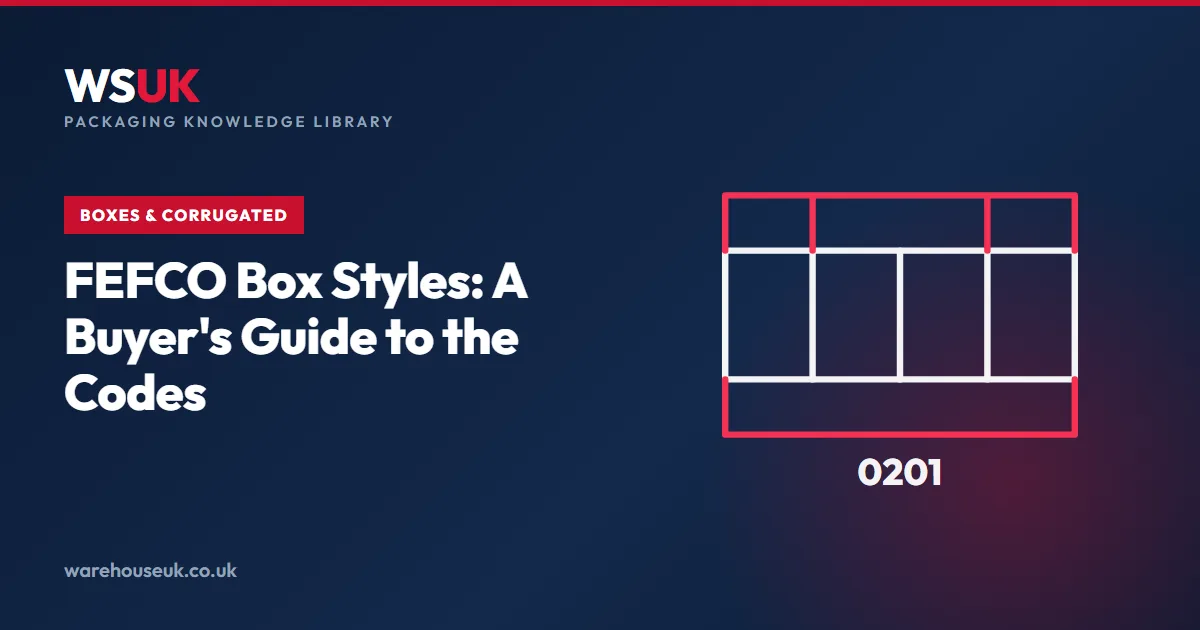
FEFCO box styles are four-digit codes from the International Fibreboard Case Code that describe how a corrugated box is cut, folded and closed. The first two digits give the family: 02 slotted, 03 telescope, 04 folder, 07 ready-glued and 09 interior fittings. A usable specification adds internal dimensions and board grade.
What a FEFCO code tells a supplier
FEFCO is the European Federation of Corrugated Board Manufacturers. Its International Fibreboard Case Code catalogues corrugated box constructions, each drawn as a flat blank with its cuts and creases and given a four-digit number. FEFCO box styles are used across the UK trade, so 0201 describes the same construction to any supplier you send it to.
The first two digits name the family and the last two a design within it. That is all the code carries: how the blank is cut, folds and closes. It says nothing about size, board or print, so an enquiry for "0201 boxes" with no dimensions or grade can be priced as two very different cartons by two suppliers.
Style is also the part of a specification buyers question least. Board grade decides whether a carton survives the stack; style decides how long it takes to build and how much tape it uses, and it is often inherited from whatever the last supplier sent. Across a corrugated packaging range, both belong in writing.
The style families most buyers use
The code runs to a large number of designs, but most UK despatch draws on five families. Slide-type and rigid-type boxes also exist but are less common in warehouse and ecommerce work.
| Series | Construction | Example | Typical use |
|---|---|---|---|
| 02 slotted-type | One piece, glued joint, flaps top and bottom | 0201 regular slotted case; 0203 full overlap | General despatch, storage, pallet loads |
| 03 telescope-type | Separate base and lid | Lid-and-base cartons | Heavy or awkward items lowered in |
| 04 folder-type | Folded from one blank, often tuck-in | 0427 die-cut mailer | Postal and ecommerce parcels |
| 07 ready-glued | Pre-glued, opens into shape | Crash-lock base styles | High-volume benches |
| 09 interior fittings | Pads, partitions, liners, sleeves | Divider sets, base pads | Separating or restraining contents |
02: slotted boxes, including the 0201
The 0201 regular slotted case is the most common carton in the UK: four flaps top and bottom, the outer flaps meeting along the centre. It ships flat, uses board efficiently and almost any supplier can run it. Its cost sits at the bench, because the base is taped before packing and the top after. The 0203 has full overlap outer flaps, putting extra board across the top and bottom faces where the base takes rough handling or the top carries weight, at the cost of a larger blank.
03: telescope boxes
A base with a lid that slides over it, part of the way or to full depth. The product is lowered into an open tray rather than past a set of flaps, which suits heavy or awkward items and anything opened repeatedly in storage. A full-depth lid gives the sides two layers of board.
04: folder boxes and the 0427 mailer
The 0427 is the die-cut mailer with a tuck-in front and dust flaps that most ecommerce brands will recognise. It closes without tape, presents well and can be sized to letterbox depth. Because it is die-cut, a new size needs a cutting forme, so it is a tooling decision as well as a box decision.
07 and 09: ready-glued boxes and fittings
Crash-lock bases sit in the 07 series: the box arrives flat but pre-glued, and pushing it open locks the base, leaving only the top to close. Expect a higher unit price than a slotted case of the same size. The 09 series covers what goes inside an outer, such as pads and partitions, specified against the same internal dimensions as the box they fit.
Writing a complete carton specification
Style. The FEFCO code, plus any variation from the standard drawing, such as a different top closure.
Internal dimensions. Length, width and depth in millimetres, measured inside. By convention length and width describe the opening, length being the longer side, and depth runs at right angles to it. So 400 x 300 x 200 mm and 300 x 200 x 400 mm enclose the same space but are different boxes: a shallow carton loaded through its largest face, and a tall one with a small opening. On an 0201 that changes the flaps, the blank and how the product goes in.
Board grade. Flute and liners, chosen for the stack load and the journey. Style and grade interact: a full overlap flap or a full-depth lid adds board exactly where load is carried, which is worth weighing against a heavier board.
A FEFCO code describes how a box is built, not how big it is or what it is made from: specify style, internal dimensions and board grade together.
What the style does to pack rate and tape
On an 0201 the packer folds and tapes the base, packs, then folds and tapes the top: two tape runs and a turn of the box. A crash-lock base removes the first half, which is why the WSUK Packaging Guide notes that crash-lock bases take seconds out of every order at the bench. A tuck-in 0427 needs no tape but takes practice to fold quickly.
| Style | Base | Top | Tape runs | Unit price |
|---|---|---|---|---|
| 0201 slotted | Fold and tape | Fold and tape | Two | Lowest for the size |
| 0203 full overlap | Fold and tape | Fold and tape | Two | Higher: larger blank |
| Crash-lock (07) | Locks on opening | Tuck, tape or peel-and-seal | None or one | Higher: pre-glued |
| 0427 mailer | Folded | Tuck-in lid | None | Tooling on new sizes |
Whether the faster style pays depends on volume. A few dozen parcels a day rarely recovers the extra cost of a crash-lock box; a bench packing hundreds of one size may. Time ten packs of each style on your own bench, multiply the difference by annual orders and your labour rate, and set that against the price difference per box. That calculation sits behind any fulfilment packaging specification. Measure tape the same way: seal a dozen cartons from a fresh 66, 100 or 150 metre roll and see how much has gone.
Parcel or pallet: matching style to the journey
Parcel. A parcel travels alone, is dropped and conveyored, and is priced on size and weight bands. Die-cut 0427 mailers and crash-lock boxes cover most small and medium parcels; 0201 cases take the larger and heavier ones. A few millimetres can move a parcel into the next band on every order, which is why postal and parcel packaging is sized against carrier bands first. Our article on postal boxes and mailers compares the formats.
Pallet. Stacked cartons carry the load above on their walls. Slotted cases sized to the pallet footprint without overhang, which weakens the stack, are the workhorses. Die-cut mailers are rarely right as pallet outers, because short walls and tuck-in lids are designed for a parcel, not a column load.
Reading a carton quote
A quote line should let you rebuild the box from the words alone. An illustrative line, not a price or a recommendation: FEFCO 0201, 450 x 350 x 300 mm internal, double wall BC flute to a stated grade, plain. Check that the style matches your bench, since a switch from crash-lock to 0201 at a requote can look like a saving and come back as labour. Check the dimensions are internal and in length, width, depth order. Check the grade is stated in full, because "double wall" alone does not describe a board. And check pack quantities and run tolerance: on WSUK terms, corrugated runs are delivered within ten per cent either way and charged as delivered.
Line competing quotes up by style, dimensions and grade before looking at price; if any differ, you are comparing two different boxes. Stock 0201 sizes from packaging supplies are usually cheapest where a standard size fits. Where it does not, bespoke carton manufacture produces the style to your internal dimensions, with a sample approved before the run.
Have your box styles specified
Send us product dimensions and weights, how the orders travel and how many your bench packs a day. We will specify style, internal dimensions and board grade together, and sample anything made to size before the run.
Frequently asked questions
What does FEFCO stand for?
The European Federation of Corrugated Board Manufacturers. It publishes the International Fibreboard Case Code, which numbers box constructions so buyers and suppliers describe the same design.
What is a 0201 box?
The regular slotted case: a one-piece carton with four flaps top and bottom, the outer flaps meeting along the centre. It is the most common UK carton and is normally taped top and bottom.
What is the difference between a 0201 and a 0427?
A 0201 is a taped slotted case for general despatch and pallet loads. A 0427 is a die-cut folder-type mailer with a tuck-in front that closes without tape, used mainly for parcels.
Does a FEFCO code include size and board grade?
No. It describes only the construction. A complete specification also needs internal dimensions in length, width, depth order and the board grade.
Are crash-lock boxes worth the extra cost?
On high volumes of the same size they often are, because they save bench time on every order. Time packs in each style and compare the labour saving with the price difference over a year.